


TL;DR
- Lower explosion risk did not mean zero risk, which is why thousands of residents remained under evacuation orders on May 26, 2026.
- Officials separated the reduced threat of a catastrophic blast from the continued possibility of a smaller fire, spill, or hazardous release.
- About two-thirds of displaced residents were allowed to return, but the remaining zone still covered people closest to the site.
- Evacuation decisions were based on changing conditions inside the tank, not public frustration or the amount of time people had been away.
- This is the kind of update readers need explained in plain language because the nuance matters.
Why This Question Matters
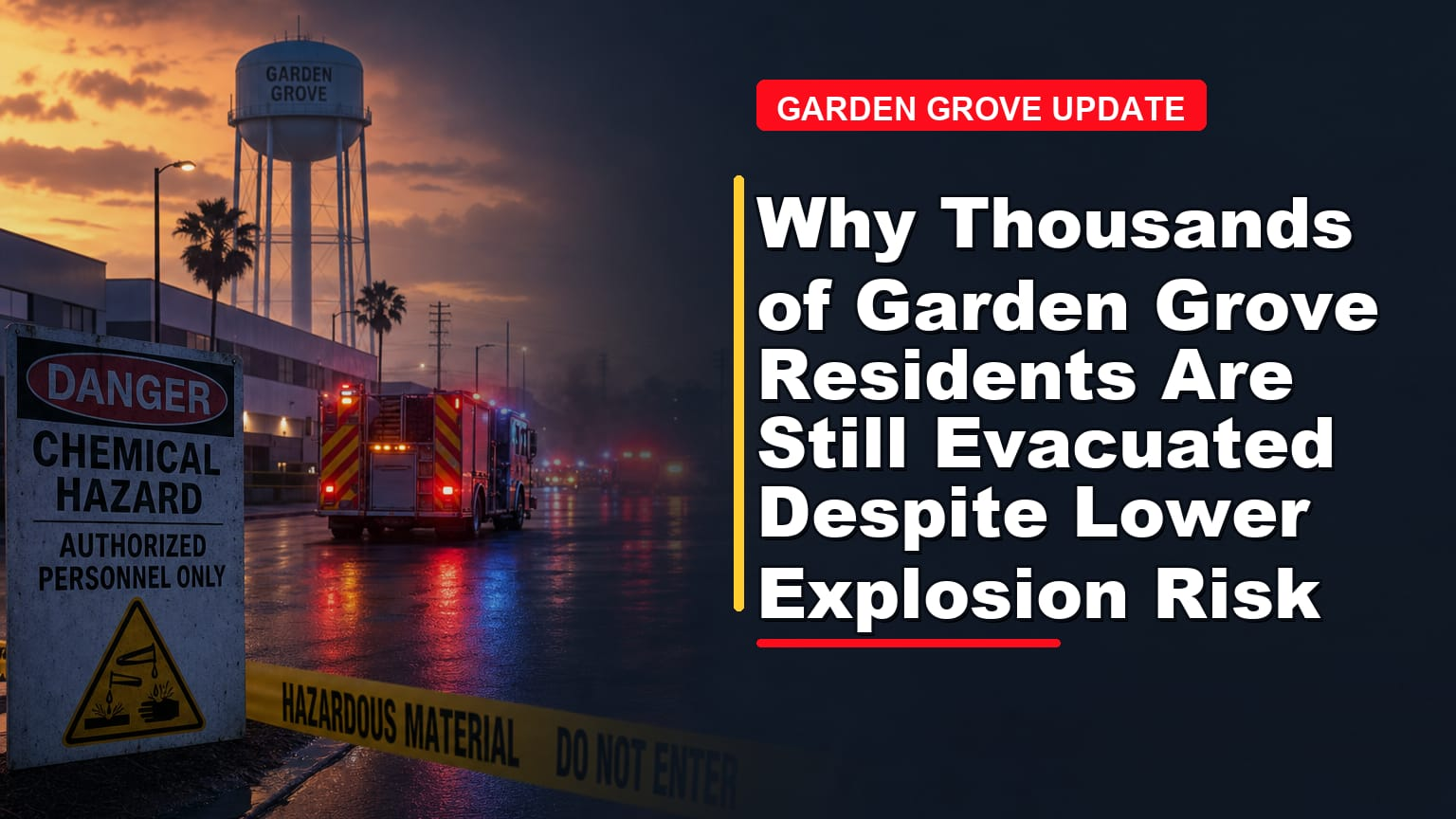
On Thursday, May 21, 2026, emergency crews responded to GKN Aerospace in Garden Grove after a storage tank containing methyl methacrylate began overheating and venting. Over the next several days, the situation grew from a site-specific industrial problem into a regional public safety emergency. Evacuation orders expanded, road closures spread, shelters opened, and families across Orange County were forced to make quick decisions without knowing how long the disruption would last. By Monday, May 25, 2026, officials said the danger of a catastrophic explosion had dropped, but they were careful not to call the incident over. Thousands of people were still under evacuation orders on Tuesday, May 26, 2026, while crews continued cooling, monitoring, and planning for the next phase.
What made this incident different from a routine hazmat response was the way it reached into ordinary life. Residents had to leave homes, workers had to change plans, local roads were affected, and schools and community facilities were pulled into the response effort. Even people outside the final evacuation zone were dealing with warnings, conflicting rumors, strong odors, and a basic question: how serious is this right now? For local readers, that is the real center of the story. A chemical emergency is not only about technical details inside a tank. It is also about how public agencies communicate risk, how neighborhoods absorb disruption, and how long it takes before people feel safe again.
The Phrase Lower Risk Can Be Misleading
One of the hardest things about emergency communication is that the public hears reduced risk and naturally translates it into safe. That is understandable, but it is not how incident commanders work. A lower risk of catastrophic explosion only addresses one scenario. It does not erase every other danger that comes with a compromised chemical tank. That is why the May 26, 2026 update confused some residents. They saw headlines about people returning home and assumed everyone should be able to do the same. In reality, emergency officials were making a narrower statement: conditions improved enough to reduce the zone, not enough to eliminate it. That distinction is the heart of this article and the reason it is useful to readers who want a straight answer instead of general reassurance.
Why Some Residents Could Return and Others Could Not
Evacuation lines are never just circles around a point on a map. They reflect changing calculations about pressure, heat, wind, spill pathways, and the practical challenge of protecting people if conditions worsen quickly. In the Garden Grove incident, the reduced zone still left about 16,000 residents affected because officials believed the people closest to the site remained exposed to the highest residual risk. That is why one block, one neighborhood, or one side of a boundary can be treated differently from another. To someone living through it, that can feel arbitrary. From a response standpoint, it is usually a sign that the map is being narrowed as new data comes in. A good explainer should help readers understand that evacuation maps change because the threat changes, not because public officials are making random calls.
Residual Risk Still Matters in a Chemical Emergency
Even after the most dramatic scenario fades, chemical incidents stay complicated. A flammable substance in a damaged tank can create different layers of concern at the same time: ignition risk, spill containment, vapor perception, and environmental exposure. In this case, officials continued talking about the possibility of a smaller blast or a spill because those outcomes would still be serious for nearby homes and businesses. They also continued environmental checks because people want to know not just whether a tank might explode, but whether the surrounding area is clean, breathable, and safe to move through. That is why the phrase still evacuated is not a contradiction. It is a sign that the response has shifted from broad emergency posture to targeted risk management.
Why This Story Resonates Beyond Garden Grove
Many local readers are not following every technical update. They are looking for one practical answer: if the danger is lower, why are people still out of their homes? That question makes this a strong blog topic because it bridges official language and everyday life. It also helps people in nearby cities understand why a regional story can narrow without disappearing. For local search and local trust, this type of post is useful because it shows respect for the audience. Instead of repeating agency language, it translates the event into the real stakes for households, renters, parents, workers, and small-business owners. The best local writing does not just report the official update. It explains the logic behind it.
The Longer-Term Question Behind the Evacuation
The longer people remain displaced, the more the story turns from hazard control to public accountability. Families start asking about missed work, interrupted school routines, transportation problems, food costs, hotel expenses, and whether the same industrial risk could happen again. That is why the remaining evacuation zone matters even after the immediate headline moves on. The final group of residents still affected often reveals the hardest part of the crisis: not the first warning, but the lingering reality that not everyone gets to resume normal life at the same time. That human unevenness is exactly why this angle deserves a full-length article.