


TL;DR
- The biggest change in the last 24 hours was the reduction of the evacuation zone after officials said the risk of a catastrophic explosion had been lowered.
- Thousands of residents were allowed to return home, but about 16,000 people were still affected as of Tuesday, May 26, 2026.
- Officials continued warning that smaller risks remained, including fire, chemical release, and spill concerns.
- Pressure inside the damaged tank dropped after responders identified a crack that appeared to relieve pressure.
- The story is now shifting from immediate explosion fear to cleanup, monitoring, and long-tail community impact.
The Situation as of Tuesday, May 26, 2026
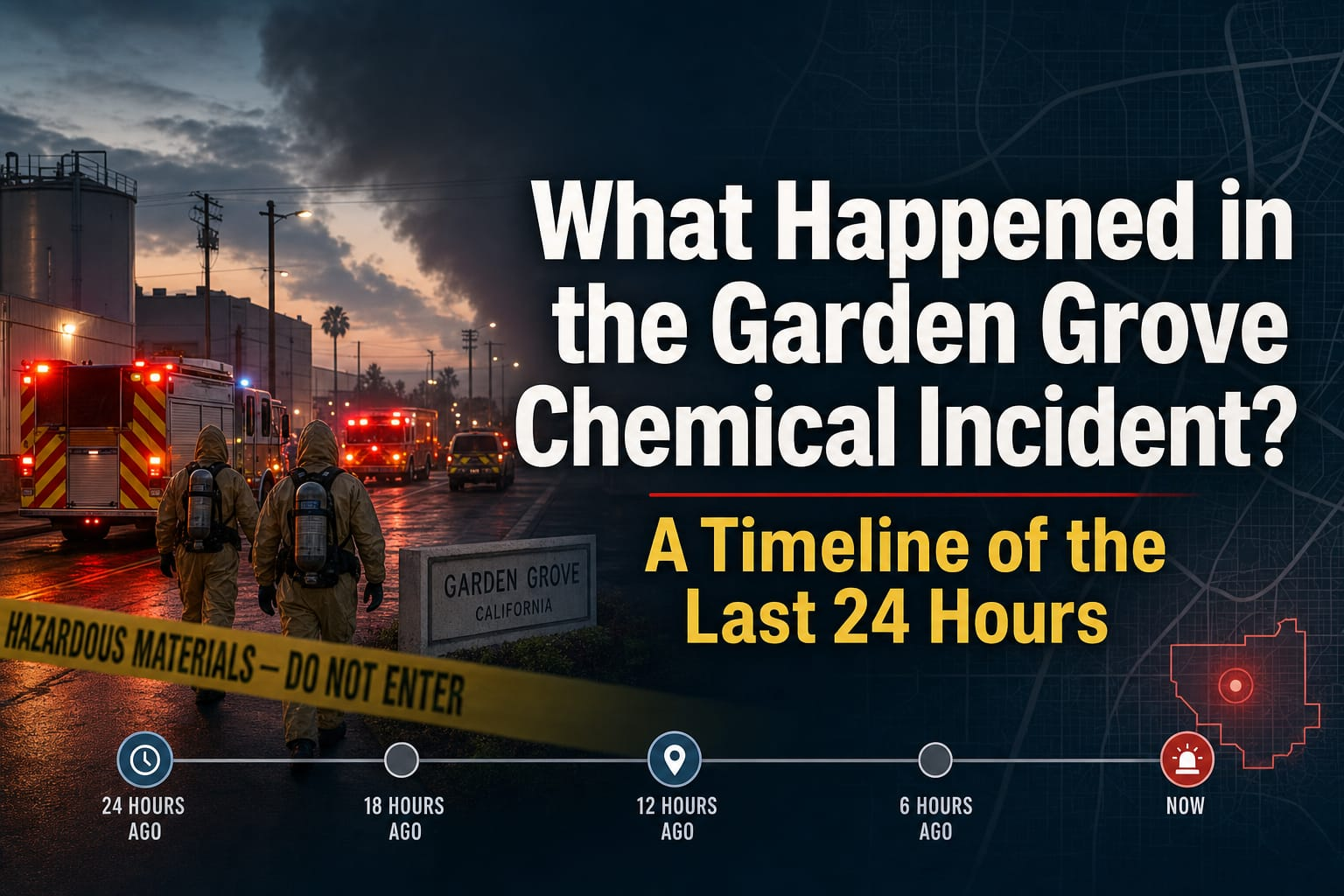
On Thursday, May 21, 2026, emergency crews responded to GKN Aerospace in Garden Grove after a storage tank containing methyl methacrylate began overheating and venting. Over the next several days, the situation grew from a site-specific industrial problem into a regional public safety emergency. Evacuation orders expanded, road closures spread, shelters opened, and families across Orange County were forced to make quick decisions without knowing how long the disruption would last. By Monday, May 25, 2026, officials said the danger of a catastrophic explosion had dropped, but they were careful not to call the incident over. Thousands of people were still under evacuation orders on Tuesday, May 26, 2026, while crews continued cooling, monitoring, and planning for the next phase.
Officials have said the tank held roughly 6,000 to 7,000 gallons of methyl methacrylate, a flammable industrial chemical used in plastics manufacturing. The emergency response centered on heat, pressure, spill risk, and public exposure concerns. Orange County Fire Authority crews spent days cooling the tank and surrounding equipment, while environmental agencies monitored air quality and prepared for the possibility of runoff or drainage contamination. State and federal resources were drawn in as the scale of the incident became clearer. That combination of industrial hazard, evacuation logistics, and lingering uncertainty is why the story has remained so important even after the worst-case explosion scenario eased.
The Incident Moved Into a New Phase
The last 24 hours changed the public conversation around the Garden Grove chemical incident. Earlier coverage focused on a possible catastrophic tank failure. By Monday evening and into Tuesday, officials were describing a narrower, though still serious, set of risks. That distinction matters. When emergency managers say the worst-case scenario is less likely, they are not saying there is no threat. They are saying the response can become more targeted. In practical terms, that is why some families were cleared to return home while others remained under evacuation orders. It is also why the next wave of reporting has to be more precise. Readers no longer need broad alarm. They need a careful explanation of what improved, what did not improve, and what agencies are still watching hour by hour.
What Changed Between Monday and Tuesday
The most important operational change was the reduced evacuation zone. Fire officials said overnight evaluation showed lower pressure in the tank, helped in part by a crack that appeared to relieve some of the internal buildup. Temperatures also continued moving in the right direction. Those facts allowed responders to redraw the danger area instead of keeping the earlier, broader map in place. That update had immediate consequences for residents, schools, roads, and businesses. It also changed the way the public should think about the event. A shrinking zone is a good sign, but it is not a finish line. The emergency response still requires containment, monitoring, environmental review, and a clear plan for the remaining hazard.
Why Officials Still Sounded Cautious
Official briefings remained careful for a reason. The danger of a massive explosion may have eased, but crews were still dealing with a damaged industrial tank containing a flammable chemical. That means the language had to shift from catastrophic failure to residual risk. A smaller blast, a flare-up, a spill, or secondary contamination concerns can still disrupt neighborhoods and force agencies to maintain a heavy presence. This is also why residents outside the narrowed evacuation line were told not to confuse improved conditions with a complete all-clear. Good emergency communication does not flatten risk into simple yes-or-no terms. It explains the difference between the most extreme danger and the hazards that remain on the table even after progress is made.
Why the Last 24 Hours Matter for Future Coverage
A timeline article built around the last 24 hours gives readers something they often do not get during fast-moving emergencies: order. Rumors, map screenshots, social posts, and fragmented headlines can create more confusion than clarity. A strong timeline lets a local audience follow the turning points. When did the risk change? When did the zone shrink? When were residents allowed to return? What did fire officials actually say about ongoing hazards? Those are the questions people ask after the adrenaline fades. They also create strong search intent because readers want a clean recap, not just another headline. That is why this angle works so well as a first long-form post.
What Comes Next From Here
The next chapter of this story will likely focus on stabilization, investigation, and accountability. Residents will want to know when the remaining evacuation orders end, whether there was any environmental release beyond what officials first described, and what records exist about the tank, the facility, and prior safety controls. Reporters and bloggers should also watch for updates about air monitoring, drainage protections, and agency coordination. A good local article does not stop at the moment a risk declines. It stays with the story long enough to explain how the emergency response becomes a recovery response, and how recovery eventually becomes a public record question. That is where this incident is headed now.
Why This Story Still Matters
Even as the immediate hazard picture improves, the Garden Grove incident remains one of the most important local Orange County stories of late May 2026 because it combines public safety, industry, environmental oversight, and community disruption in one event. Readers are not only looking for raw updates. They are looking for interpretation that is careful, current, and useful. A strong long-form post should slow the story down just enough to make it understandable. It should name what changed, what did not change, and why neighbors, workers, and families should still pay attention. That is the difference between content that chases a headline and content that actually helps the local audience.
Why People Seek Guidance After Incidents Like This
Not every reader of these posts will need legal help, and a careful article should not pretend otherwise. But many people do finish a week like this with real questions. If they missed work, paid for temporary housing, worried about possible exposure, or simply feel unsure about what comes next, they often want to understand their rights and options from someone local who takes the disruption seriously. That is why a measured call to action makes sense at the end of these articles. It is not about pressuring people during an emergency. It is about letting affected families know that help exists if they need answers once the immediate confusion settles.
Call the Law Offices of Jacob Emrani
If you or your family were displaced, exposed, or left with questions after the Garden Grove chemical incident, it helps to talk with a team that understands how serious a sudden emergency can become. The Law Offices of Jacob Emrani can help you understand your options and what steps may make sense next. Call (800) 3-4-5-6-7-8-9 for help.