





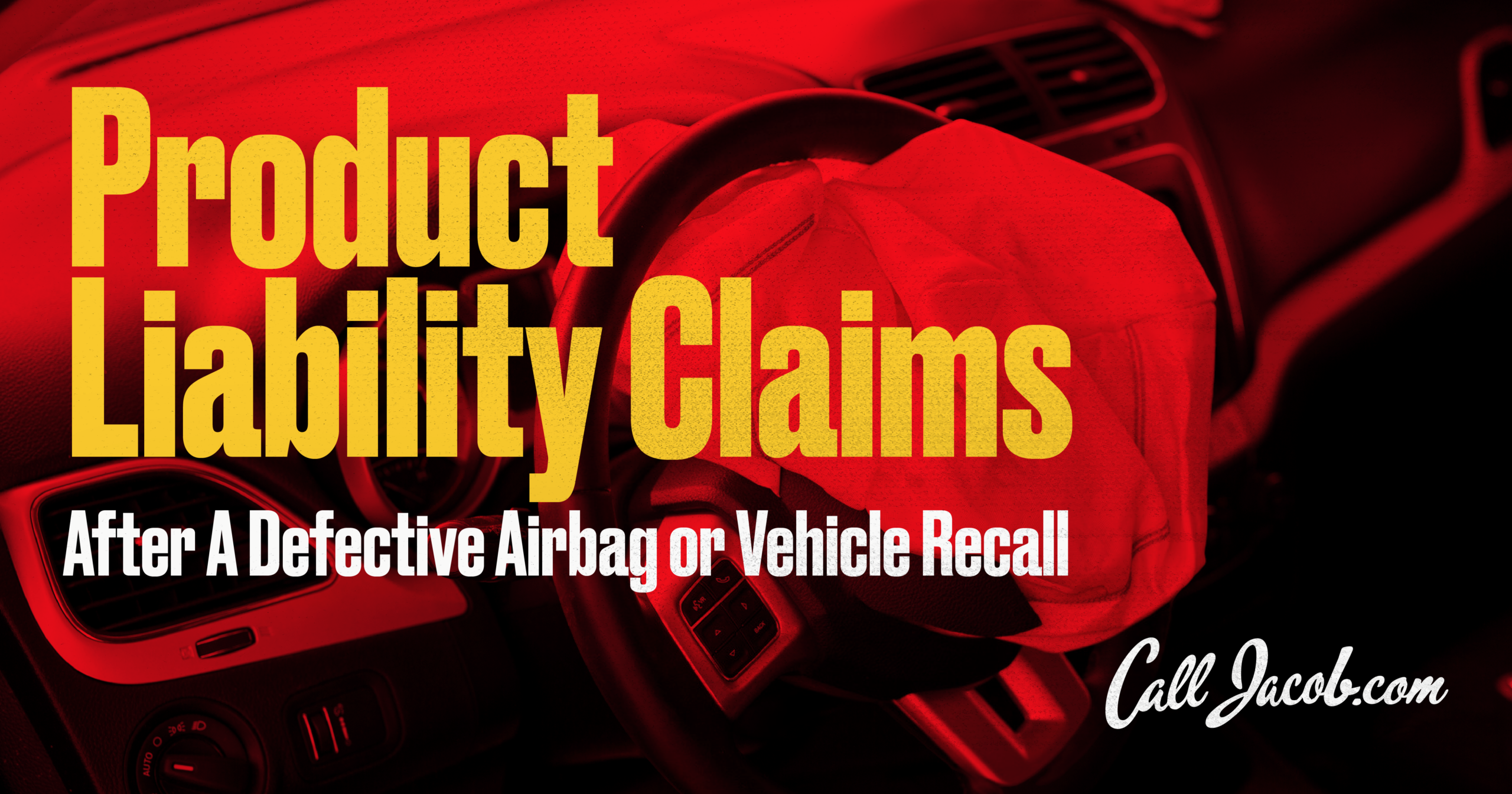
A serious car accident is challenging on its own — dealing with injuries, medical care, and time away from work — but when a defective airbag or recalled vehicle part contributed to your injuries, it becomes even more complicated, often involving multiple liable parties, additional investigation, and a more complex claims process.
If you’re considering a product liability claim because of a defective airbag or vehicle recall, it’s important to understand how product liability cases differ from standard accident claims. In California, injured victims may pursue compensation not only from negligent drivers but also from manufacturers, suppliers, or distributors responsible for unsafe vehicle components.
What Is Product Liability in California?
By law, automotive product liability in California does not typically require individuals to prove negligence by the manufacturer, supplier, or distributor. Instead, they must show that a product defect caused or contributed to their injuries.
There are three primary types of product defects:
- Design defects, where the product is inherently unsafe.
- Manufacturing defects, when a product deviates from its intended design due to an error in the manufacturing process.
- Failure to warn, where adequate safety instructions or warnings are missing.
According to the National Highway Traffic Safety Administration, manufacturers are required to notify consumers and correct safety-related defects. However, a recall does not automatically shield the manufacturer from liability if injuries occur.
How Defective Airbags Cause Serious Injuries
Airbags are designed to save lives, but when they malfunction, they can cause catastrophic harm. A defective airbag injury claim often involves situations where airbags deploy incorrectly, fail to deploy, or deploy with excessive force.
Common injuries linked to defective airbags include:
- Traumatic brain injuries
- Facial fractures and burns
- Chest and rib injuries
- Neck and spinal damage
In severe cases, victims may sustain injuries that qualify as a catastrophic injury, affecting their ability to work and maintain daily independence long-term.
What Is a Vehicle Recall and Why Does It Matter?
A vehicle recall occurs when a manufacturer or regulatory authority identifies a safety defect that poses a risk to drivers, passengers, or other road users. Recalls can involve airbags, brakes, steering systems, and other critical components.
A vehicle recall lawsuit in California may arise when an injury occurs before the defect is repaired or when the recall remedy fails to correct the problem.
In California product liability cases, recalls are often used as supporting evidence that a safety-related defect was identified in a vehicle or component, even though additional proof is still required to show how it contributed to the injury.
Can You File a Lawsuit After a Vehicle Recall?
A lawsuit involving a recalled vehicle may be filed if a defective part caused or contributed to an accident or injury. The fact that a recall was issued does not prevent a claim from being brought and may strengthen your claim by demonstrating that:
- The manufacturer was aware of the defect.
- The defect posed a safety risk.
- The vehicle failed to perform safely as expected.
For example, if an airbag recall was issued due to faulty deployment mechanisms and the airbag failed during a collision in a high-traffic region like Los Angeles, where accident volumes are among the highest in California, you may have grounds for both a personal injury claim — in which case you would want to speak with a personal injury attorney in Los Angeles — and a product liability case, particularly when a defective component contributed to the severity of your injuries.
Who Can Be Held Liable for a Defective Airbag or Vehicle Defect?
Product liability cases often involve multiple potentially responsible parties, and liability may extend beyond the vehicle manufacturer.
Common defendants in a defective vehicle parts lawsuit include:
- Vehicle manufacturers responsible for overall design and assembly.
- Parts manufacturers that produced the defective component.
- Distributors and suppliers within the supply chain.
- Dealerships that sold the defective vehicle without proper disclosure.
Determining liability requires a detailed investigation into how the defect occurred, whether it existed when the product left the manufacturer, and whether it contributed to the injuries.
Evidence Used to Prove a Product Liability Claim
To succeed in a product liability claim involving a defective airbag or other defect, strong evidence is essential. Unlike standard car accident cases, these claims rely heavily on technical and expert analysis.
Key evidence may include:
- Vehicle recall notices and repair records.
- Crash reports and accident reconstruction findings.
- Medical records documenting injuries.
- Expert testimony on product design or manufacturing flaws.
- Photographs or preserved vehicle components.
This evidence helps establish that the defect existed, caused the injury, and made the product unreasonably dangerous.
Common Defenses Used by Manufacturers
Manufacturers often aggressively challenge product liability claims because the financial exposure can be significant. In serious injury cases, damages may include long-term medical care, lost income, and pain and suffering.
Common defenses used by manufacturers include:
- The product was misused or altered after purchase.
- The consumer ignored recall notices or failed to seek repairs.
- The injury was caused by another factor, such as driver negligence.
- The defect did not exist at the time the product left the manufacturer.
Even if you were partially at fault, California’s comparative fault rules may still allow recovery for a portion of your damages.
What Compensation Is Available in a Defective Vehicle Lawsuit?
Victims of defective vehicle accidents may be entitled to several forms of compensation. These damages are intended to address both financial and personal losses.
For example, airbag malfunction injury compensation may include:
- Medical expenses, including future treatment costs.
- Lost wages and reduced earning capacity.
- Pain and suffering.
- Emotional distress.
- Property damage.
In cases involving particularly dangerous conduct, punitive damages may be awarded to hold manufacturers accountable. In the landmark case Grimshaw v. Ford Motor Co., a jury awarded $125 million in punitive damages (later reduced on appeal) in a defective vehicle case.
Why You Need a Product Liability Lawyer in Los Angeles
Product liability cases often involve large corporations, technical evidence, and extensive legal resources. They are significantly more complex than standard accident claims and can be difficult to navigate without the support of a legal professional experienced in this area of law.
Working with a product liability lawyer in Los Angeles can help with the requirements of:
- Identifying all responsible parties.
- Preserving critical evidence before it’s lost or altered.
- Working with experts to analyze the defect.
- Navigating both personal injury and product liability claims simultaneously.
Their legal guidance becomes even more important when injuries are severe or long-lasting.

Contact the Law Offices of Jacob Emrani
If you’ve been injured due to a defective airbag or recalled vehicle, the manufacturer may be held accountable for the harm their product has caused.
Understanding your rights is the first step. Whether your case involves a defective airbag injury claim or a broader car recall accident lawsuit, taking timely action can make a meaningful difference in the outcome because evidence, records, and technical details are easier to preserve and investigate early on.
To discuss your situation and explore your legal options, contact the Law Offices of Jacob Emrani for a confidential consultation.