


TL;DR
- Emergency crews spent days cooling, monitoring, and containing a damaged chemical tank at GKN Aerospace in Garden Grove.
- The response required coordination across local fire agencies, county officials, environmental monitors, and state and federal partners.
- Millions of gallons of water were used as part of the effort to reduce heat and lower the chance of a major failure.
- Crews could not simply rush in and drain the tank because the operation had to account for pressure, ignition risk, and spill consequences.
- This response story matters because it shows how difficult industrial emergencies become once neighborhoods are inside the hazard zone.
A Long-Duration Response
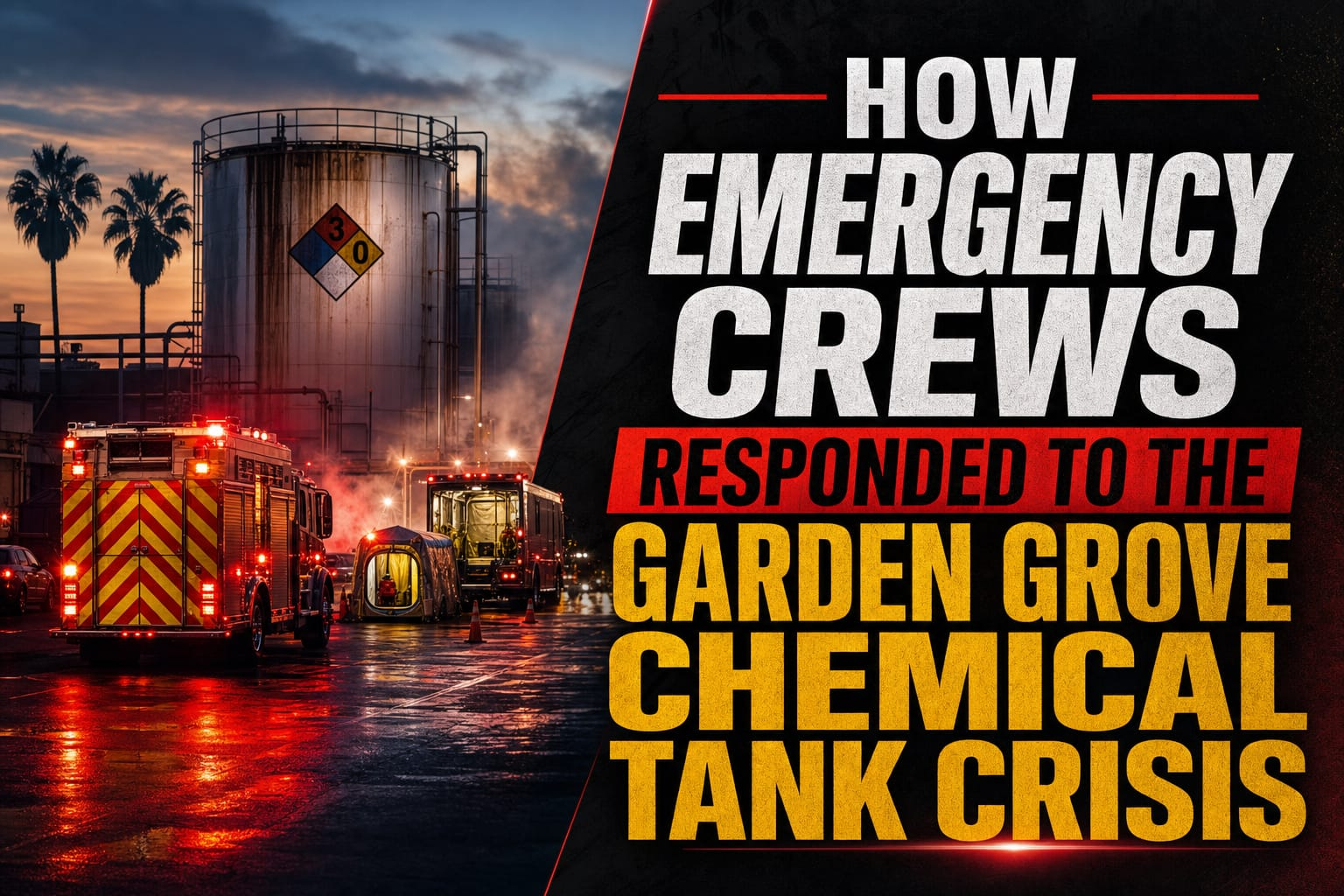
On Thursday, May 21, 2026, emergency crews responded to GKN Aerospace in Garden Grove after a storage tank containing methyl methacrylate began overheating and venting. Over the next several days, the situation grew from a site-specific industrial problem into a regional public safety emergency. Evacuation orders expanded, road closures spread, shelters opened, and families across Orange County were forced to make quick decisions without knowing how long the disruption would last. By Monday, May 25, 2026, officials said the danger of a catastrophic explosion had dropped, but they were careful not to call the incident over. Thousands of people were still under evacuation orders on Tuesday, May 26, 2026, while crews continued cooling, monitoring, and planning for the next phase.
Officials have said the tank held roughly 6,000 to 7,000 gallons of methyl methacrylate, a flammable industrial chemical used in plastics manufacturing. The emergency response centered on heat, pressure, spill risk, and public exposure concerns. Orange County Fire Authority crews spent days cooling the tank and surrounding equipment, while environmental agencies monitored air quality and prepared for the possibility of runoff or drainage contamination. State and federal resources were drawn in as the scale of the incident became clearer. That combination of industrial hazard, evacuation logistics, and lingering uncertainty is why the story has remained so important even after the worst-case explosion scenario eased.
This Was Never a Simple Put-It-Out Call
From the outside, people often imagine an emergency response in direct terms: find the danger, shut it down, and go home. The Garden Grove chemical tank crisis did not work like that. Crews were dealing with a damaged storage system, a flammable chemical, public exposure concerns, and a risk profile that changed over time. That meant the response had to be slow, deliberate, and data-driven. Firefighters were not only trying to stabilize equipment. They were also trying to protect tens of thousands of residents while preserving flexibility if conditions worsened. That kind of operation is rarely dramatic in the Hollywood sense. It is methodical, repetitive, and stressful because every action has to be weighed against the possibility of making the situation worse.
Cooling and Monitoring Became the Core Strategy
One of the clearest public details from the response was the use of sustained cooling. Crews spent days applying water and managing heat because temperature inside the tank was directly tied to the larger explosion concern. Cooling sounds straightforward, but in a chemical incident it is part of a broader control strategy. Water use, runoff planning, equipment positioning, and responder safety all have to be managed at the same time. Monitoring was just as important. Officials needed to understand whether pressure was rising or falling, whether the tank was changing shape, and whether environmental conditions around the site were shifting. That is why the public saw a long-duration operation instead of a quick tactical move. A stable outcome often comes from patience, not speed.
Why Crews Could Not Just Empty the Tank Immediately
A common public question has been why responders did not simply drain the tank right away. The answer is that transfer or removal is not a casual step when the vessel is damaged and the contents are flammable. Any operation around the tank had to account for ignition sources, equipment limitations, the condition of valves and piping, and what would happen if product escaped unexpectedly. In other words, the response team was not choosing delay for its own sake. They were trying to avoid triggering the exact failure everyone feared. This is one of the most valuable points a blog post can make because it explains the difference between what sounds easy from the outside and what is actually safe inside an industrial hazard zone.
A Regional Response for a Local Facility
Another reason this incident deserves a response-focused article is that it shows how quickly a facility problem becomes a regional incident. Evacuations extended beyond a single block. Shelters were opened. Law enforcement helped with closures and public movement. Environmental agencies tracked air and drainage concerns. State and federal resources were drawn in once the scale became clear. That layered response is not just bureaucratic detail. It tells readers how modern emergency management works when industrial risk crosses into community life. The bigger the footprint, the more agencies have to operate from a shared picture. When that coordination works, the public sometimes mistakes it for overreaction. In reality, it is usually the reason the situation does not get worse.
What the Response Story Tells Us Going Forward
The response itself is part of the public record now. Residents will want to know what worked, what took longer than expected, and what lessons agencies draw from the event once the hazard is fully resolved. Those are fair questions. A strong local blog can start that conversation without pretending to deliver a final verdict before all the facts are in. It can show readers why the operation looked the way it did, why caution dominated the public messaging, and why a long response is often the price of avoiding a much worse outcome.
Call the Law Offices of Jacob Emrani
If you or your family were displaced, exposed, or left with questions after the Garden Grove chemical incident, it helps to talk with a team that understands how serious a sudden emergency can become. The Law Offices of Jacob Emrani can help you understand your options and what steps may make sense next. Call (800) 3-4-5-6-7-8-9 for help.