


- The incident began at the GKN Aerospace site on Western Avenue in Garden Grove.
- Officials have identified the chemical involved as methyl methacrylate, often shortened to MMA.
- On Sunday, May 24, 2026, CAL FIRE still listed evacuation orders in place for the affected area.
- Shelter and care-center availability can change quickly, so residents should verify status before heading out.
- Orange County Public Information Hotline: (714) 628-7085
- Garden Grove Emergency Hotline: (714) 741-5444
- Anyone displaced by the evacuation should keep receipts, photos, screenshots, and a daily log of expenses and interruptions.
The Garden Grove chemical leak has forced thousands of Orange County residents to make fast decisions about where to go, what to bring, and how to protect their families while emergency crews work to stabilize the incident. For many people, the immediate concern is simple: where can I stay, what should I keep, and how do I document the real costs of being displaced?
As of Sunday, May 24, 2026, officials were still treating the damaged tank at the GKN Aerospace facility in Garden Grove as an active risk. State and local agencies continued to warn residents to follow evacuation orders and wait for official clearance before returning home. Even though emergency crews reported signs that pressure inside the tank may have changed, the danger had not been declared over. That matters, because people should not rely on old social posts, neighborhood rumors, or yesterday’s map when the official situation can shift by the hour.
This guide is built to answer the questions residents are actually searching for right now: where the evacuation centers are, what the current evacuation zone looks like, what expenses to document, what symptoms to watch for, and how to keep a clean record of disruption tied to the Garden Grove chemical leak.
Current Garden Grove Chemical Leak Evacuation Centers
The biggest point of confusion right now is that some earlier city updates listed initial evacuation centers, while newer state and Red Cross resources reflect the current shelter network being used on May 24. If you are searching for Garden Grove chemical leak evacuation centers or Garden Grove shelter locations, use the most recent official listings first.
According to CAL FIRE and the American Red Cross, the following evacuation shelters were listed as open on Sunday, May 24:
- Golden West College, 15744 Goldenwest Street, Huntington Beach, CA 92647
- Oceanview High School, 17071 Gothard Street, Huntington Beach, CA 92647
- John F. Kennedy High School, 8281 Walker Street, La Palma, CA 90623
- Mile Square Regional Park – Freedom Hall, 16801 Euclid Street, Fountain Valley, CA 92708
- Los Amigos High School, 16566 Newhope Street, Fountain Valley, CA 92708
- Savanna High School, 301 N. Gilbert Street, Anaheim, CA 92801
State resources also listed care centers, including:
- Ehlers Center, 8150 Knott Avenue, Buena Park, CA 90620
- Westminster Senior Center, 8200 Westminster Boulevard, Westminster, CA 92683
Pet policies vary by location. Several shelters were listed as pet-friendly, while others were not. Freedom Hall and John F. Kennedy High School were specifically identified as locations where pets were allowed and where OC Animal Care trailers were available. Golden West College was listed as a site that could not currently accommodate pets. If you are evacuating with animals, verify the latest status before you drive.
For the latest shelter status, residents should use the official hotlines:
- Orange County Public Information Hotline: (714) 628-7085
- Garden Grove Emergency Hotline: (714) 741-5444
Those numbers matter because shelter vacancy, transportation needs, and pet accommodations can change faster than a blog post can.
What the Evacuation Zone Looked Like on May 24
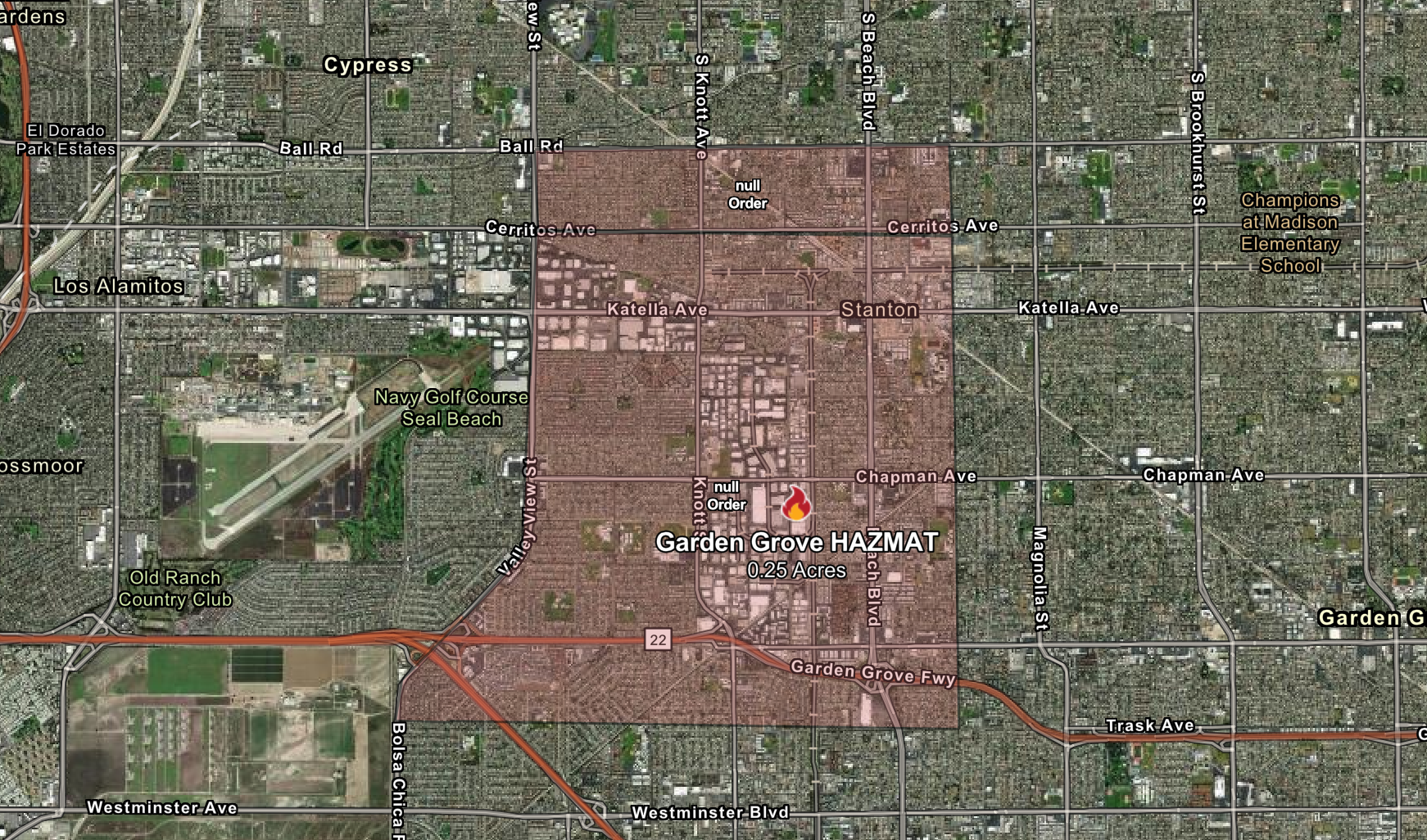
One of the most common searches today is some version of Garden Grove evacuation zone today or Garden Grove chemical leak map. On Sunday, May 24, CAL FIRE listed the evacuation order area with these boundaries:
- North: Ball Road
- East: Dale Street
- South: Trask Avenue
- West: Valley View Street
Residents should not treat that as a static forever boundary. Earlier local updates showed smaller or different evacuation footprints before the response expanded. The point is not to memorize every version. The point is to check the latest official evacuation map before making decisions about returning home, visiting a business, or sending family members back into the area.
If you are outside the evacuation zone but close enough to be concerned, that is still a reason to pay attention to official updates. It is not a reason to improvise your own return timeline.
What Residents Should Do Right Now
If you have been displaced by the Garden Grove chemical leak, the best move is to simplify your response and keep your record clean.
Start with the basics:
- Follow evacuation orders and do not return until officials lift them.
- Bring medications, IDs, insurance cards, chargers, and essential medical equipment.
- Keep every receipt tied to the evacuation.
- Screenshot official alerts, road closures, school notices, and hotel confirmations.
- Take photos of your home or business when you are able to leave and again when you return.
- Write down where you stayed each night and why.
People often think they will remember the details later. They usually do not. In a situation like this, memory gets messy fast. Receipts get lost. Email confirmations pile up. Costs blur together. If the evacuation affects you for several days, the documentation problem becomes much bigger than most people expect.
How to Document Every Evacuation Expense
This is the section many people will wish they started on day one.
If you are searching for how to document expenses after the Garden Grove evacuation or what receipts to keep after a chemical leak, the short answer is this: document anything you paid because you could not safely stay in your normal home or operate your normal routine.
That includes:
- Hotel stays
- Airbnb or short-term rentals
- Meals and groceries
- Bottled water and snacks
- Gas, parking, tolls, and rideshare trips
- Pet boarding, pet food, pet medication, and crates
- Prescription refills
- Emergency medical visits
- Childcare or elder-care costs caused by displacement
- Toiletries, clothing, and basic necessities purchased because you were away from home
- Missed work, canceled appointments, and business interruption
The cleanest system is a simple spreadsheet with five columns:
- Date
- Vendor
- Amount
- Category
- Notes
For example, instead of writing only “Marriott – $248,” make the note useful:
- “Hotel stay due to Garden Grove evacuation order, family of four, one night”
Instead of:
- “Target – $84”
Write:
- “Toiletries, diapers, chargers, socks purchased after emergency evacuation”
That level of detail saves time later and gives the record context that a bank statement alone does not provide.
What Proof to Save
At a minimum, residents should save:
- Printed or digital receipts
- Credit card statements or screenshots
- Hotel confirmations
- Gas station receipts
- Screenshots of official evacuation orders
- Proof of address showing you were inside the affected zone
- Photos of conditions at your property when you are able to return
- Employer notices about missed shifts or business closures
- School closure notices or childcare interruptions
If you own a business in or near the affected area, also keep:
- Daily sales comparisons
- Cancellation emails
- Staffing records showing reduced hours or closures
- Delivery interruptions
- Vendor communications tied to the shutdown
You do not need a fancy system. You need a system you will actually keep using.
Why Good Documentation Matters
People often hear “save your receipts” and treat it like generic advice. It is more than that.
In any major evacuation or hazardous-material incident, the paper trail becomes the difference between a vague story and a usable record. A clean record helps establish what happened, when it happened, and what it cost you in real terms. That is true whether you are dealing with insurance questions, reimbursement discussions, landlord issues, business-loss questions, or simply trying to rebuild your own timeline after a disruptive week.
The more specific your record is, the less likely you are to miss real costs. Most people remember hotel bills. They forget parking. They forget extra pet costs. They forget the second pharmacy run, the extra school pickup mileage, or the meals purchased because they had no access to their kitchen. Those smaller costs add up fast.
Symptoms and Health Concerns to Watch
The chemical involved in the incident has been identified as methyl methacrylate, or MMA. Official CDC and NIOSH references say exposure can irritate the eyes, skin, nose, and respiratory system. That does not mean every nearby resident was exposed at a dangerous level, and it does not mean every symptom is automatically tied to the incident. It does mean residents should take irritation symptoms seriously and avoid freelancing around the evacuation zone.
People should seek medical attention promptly if they experience:
- Trouble breathing
- Severe eye irritation
- Persistent coughing
- Chest tightness
- Skin irritation after possible exposure
- Any worsening symptoms that concern them
If you do seek care, document that too. Save discharge paperwork, visit summaries, prescriptions, and receipts. If a symptom appears after the evacuation period, write down when it started and what happened before it appeared.
Schools, Work, and Daily Disruption
Another major search pattern here is not just where to evacuate, but what do I do if school, work, or business operations are interrupted.
For families, that means documenting:
- School closures
- Missed classes
- Childcare substitutions
- Transportation changes
- Out-of-pocket costs from the disruption
For workers, it means documenting:
- Missed shifts
- Reduced hours
- Employer communications
- Commute changes caused by road closures
For business owners, it means documenting:
- Days closed
- Canceled bookings
- Lost foot traffic
- Delayed deliveries
- Staff scheduling changes
You do not need to turn a stressful situation into a legal memo. You just need a factual log that you can trust later.
Frequently Asked Questions About the Garden Grove Chemical Leak
Where are the Garden Grove chemical leak evacuation centers?
As of May 24, official shelter locations included Golden West College, Oceanview High School, John F. Kennedy High School, Freedom Hall at Mile Square Regional Park, Los Amigos High School, and Savanna High School. Care centers included Ehlers Center and Westminster Senior Center.
What is the Garden Grove evacuation zone today?
On Sunday, May 24, CAL FIRE listed the evacuation order area as Ball Road to the north, Dale Street to the east, Trask Avenue to the south, and Valley View Street to the west.
What should I bring to an evacuation center?
Bring medications, IDs, insurance cards, chargers, pet supplies, comfortable clothing, and any essential medical or child-care items you need for at least a couple of days.
What expenses should I document after the evacuation?
Document lodging, food, gas, rideshare, parking, pet costs, prescriptions, emergency supplies, childcare, elder care, and any lost income or business interruption connected to the evacuation.
Can I go home if the smell seems gone?
No one should use odor alone as a safety test. Residents should return only when officials lift the evacuation order for their specific area.
Garden Grove chemical leak is not just a breaking-news story
The Garden Grove chemical leak is not just a breaking-news story. For residents, it is a disruption with practical consequences: where to sleep, what to bring, how to protect pets, how to manage missed work, and how to document every dollar spent while waiting for the all-clear.
The safest approach is also the most useful one: follow current official instructions, verify shelter status before you travel, and start a clean evacuation record now instead of trying to reconstruct it later. If you were displaced, your documentation should begin with the first night you had to leave home and continue until normal life actually resumes.
That gives you something better than a pile of receipts. It gives you a usable record of what this incident cost you and how it affected your household.
Sources
- CAL FIRE Garden Grove HAZMAT incident page
- American Red Cross Southern California hazmat response updates
- Cal OES community resource page for the Garden Grove hazmat incident
- City of Garden Grove emergency updates page
- Associated Press reporting from Sunday, May 24, 2026
- CDC/NIOSH methyl methacrylate guidance