





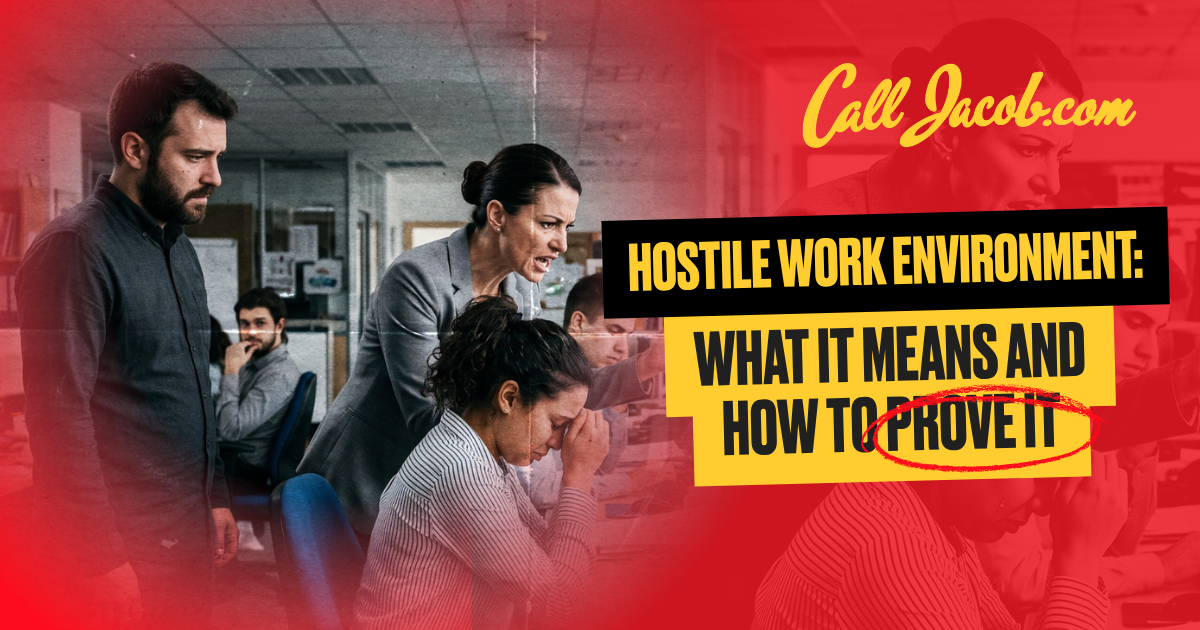
Workplaces aren’t always easy. Frustrating bosses, difficult coworkers, and relentless deadlines are common realities—but some workplace conditions go further. Hostile work environments where harassment, belittling, or targeting become the norm cross a legal line. Unlike everyday frustrations, these conditions can give rise to legal claims that protect a worker’s rights and secure fair compensation. Here’s what you need to know about this often-misunderstood area of law and how to build a claim.
What Is a Hostile Work Environment?
Under California’s Fair Employment and Housing Act, a hostile work environment is a form of workplace harassment that includes “unwelcome conduct that is based on race, color, religion, sex (including sexual orientation, transgender status, or pregnancy), national origin, older age (beginning at age 40), disability, or genetic information (including family medical history).” Workplace hostile environment harassment rights are also protected by federal law under the United States of America’s Civil Rights Act.
A hostile work environment claim requires three main components, and all three must be present to support a legally viable claim.
The first is that the form of harassment must be based on a “protected characteristic” under a worker’s rights. California’s list of protected characteristics includes race, religion, sexual orientation, age, disability, marital status, pregnancy, and veteran or military status.
The second is that workplace harassment in California is deemed unwelcome. This means the targeted employee did not invite, encourage, or participate in the behavior reported in the claim.
The last, and perhaps the most complicated, requirement is that the courts must consider the harassment severe. For example, one off-color or ill-intentioned joke won’t stand up in a legal sense unless it’s extremely severe. The law is instead searching for a pattern of these kinds of jokes or other bad behavior that creates a hostile work environment.
Examples
To better understand what it is, let’s look at a few examples of a hostile work environment.
Suzie is part Sikh and wears a dastar or turban to work. Her supervisor sometimes makes derogatory comments about her ethnicity, sometimes using slurs, or tells racially offensive jokes to other employees. This pattern is a form of racial harassment that would be considered a hostile work environment.
Let’s look at another. Maggie works in a cubicle next to her co-worker John. John has repeatedly asked Maggie to go out for a drink, even after she said no and that it was inappropriate. John also sometimes leans on Maggie’s desk while she’s working and has grabbed her leg on multiple occasions. When she reports him to human resources, nothing is done.
After she brings it up with her boss, he tells her that John is “just like that with all the pretty women.” This is a form of sexual harassment that has made Maggie’s work environment a hostile one. Maggie can sue John and the company for her supervisor turning a blind eye.
Workplace harassment that is based on disability or religion also qualifies. Let’s say there is an employee who is constantly mocked for a physical or mental impairment, or an employee who is ridiculed for their religious beliefs or practices. These are strong claims of a hostile work environment, especially if the behavior is ongoing and tied to the employee’s protected status.
How to Prove It
Proving a hostile work environment claim is harder than simply telling your side of the story, which is why it’s imperative to work with a workplace harassment lawyer, like the Law Offices of Jacob Emrani. We will help you build your claim and make a persuasive case, which is needed to win and earn you fair compensation.
The first thing a court will look for is a pattern of harassment. The courts are always more likely to find a hostile work environment when the harassment occurred regularly over a period of time rather than as an isolated incident. The more consistent the pattern with evidence, the stronger the claim.
The next is the severity of the harassment. The pattern and severity of harassment are always tied together. A single incident can sometimes be severe enough on its own to support a claim, especially when it involves physical assault, an explicit verbal threat, or an extremely serious act of discrimination.
Whether the conduct was physically threatening or humiliating, rather than merely offensive, is another factor courts will consider. For example, harassment that degrades an employee in front of coworkers, or that involves any physical element, is treated more seriously than verbal harassment.
The last factor is whether or not the harassment interfered with the employee’s ability to work. If it was so disruptive that it caused the employee to take time off or even forced them to resign, these issues are taken seriously.
Evidence Needed
To make a strong hostile work environment claim, you need to think like a detective on a subjective level and build evidence. A harassment attorney can help you with this process, but it’s important to understand what kinds of evidence are needed.
- Written documentation: Keep a detailed logbook of every incident, including the date, time, location, what was said or done, who was present, and how you responded. Try to do this right after the incident, so it’s fresh in your mind. A court will appreciate this, and it will strengthen your case.
- Other physical evidence: This includes emails, notes, voicemails, social media posts, and any physical evidence that shows harassment is present and that management was clearly aware. Basically, never delete anything and make printout copies to build your case.
- Witness testimonies: If a co-worker or supervisor was present during the harassment incident, get them to provide statements, or in some cases, ask them to testify on your behalf.
- Document any reports: If you’ve made a complaint to your HR rep, make a copy of this as well to show that management was aware. If this was done verbally, send a follow-up email saying what was discussed.
- Medical reports: If the form of harassment you were subjected to resulted in causing you any harm, physical or psychological, such as depression or anxiety, keep these reports to put them in your case.
Call Jacob Emrani To File A Hostile Work Environment Claim
If you believe you are dealing with a hostile work environment, don’t wait for the situation to resolve itself. Start building evidence to support your claim and work together with California’s top workplace harassment lawyer. Jacob Emrani will fight for your rights and get you the fair outcome and compensation you deserve. Contact us today for a free consultation.